Material data is often created with urgency. A new spare part is required. A project demands a specific component. A breakdown forces immediate action. In these moments, the priority is speed, not longevity. The material record is created, the transaction proceeds, and operations move on.
What is rarely considered is what happens next.
Material data does not remain static. It lives within the system long after the original need has passed. It is reused, copied, modified, referenced, duplicated, and sometimes forgotten. Over time, the material master grows, not only in volume, but in complexity.
Without deliberate lifecycle management, material data becomes an unmanaged asset. The consequences are subtle at first. Eventually, they become structural.
This article explores the concept of material data lifecycle management: how material data should be governed from creation to maintenance and finally to phase-out, and why this lifecycle perspective is essential for sustainable operational performance.

Material Data Has a Lifecycle, Whether Managed or Not
Every material record follows a lifecycle, even if the organization does not explicitly define one.
A material is created. It is used. It may be modified. It may become inactive. In many cases, it remains in the system indefinitely, regardless of relevance.
The difference between controlled and uncontrolled environments is not whether a lifecycle exists, but whether it is managed intentionally.
When lifecycle stages are not defined, material data accumulates. Obsolete items coexist with active ones. Duplicates remain indistinguishable. Historical records blur with operational data. Over time, clarity is lost.
Is the material master still a decision-support asset, or has it become a historical archive with operational side effects?
Creation: The Most Critical and Most Neglected Phase
Material data creation is the single most important point in the lifecycle. Decisions made at this stage determine everything that follows.
During creation, the material is named, classified, attributed, and positioned within the system. This definition becomes the reference for procurement, inventory, maintenance, and reporting. If it is incomplete or inconsistent, every downstream process inherits that weakness.
Yet creation is often treated as a clerical step.
Under operational pressure, materials are created quickly. Free-text descriptions are used. Attributes are skipped. Classification is approximated. The immediate need is satisfied, but long-term governance is compromised.
How many future issues originate from a single rushed creation decision?
Creation Without Standards Creates Permanent Debt
Poorly created material data does not correct itself over time. It creates what can be described as data debt.
Each duplicate created increases complexity. Each ambiguous description reduces search effectiveness. Each missing attribute limits analysis. Each local convention fragments global visibility.
This debt accumulates silently.
Over time, the organization spends more effort working around data limitations. Manual checks increase. Exceptions become common. Trust in the system declines.
Data debt is not visible on balance sheets, but it is paid daily in operational friction.
Maintenance: Where Data Either Evolves or Degrades
Once created, material data enters its longest phase: maintenance.
During this phase, materials are issued, received, modified, extended to new locations, linked to vendors, and referenced in transactions. Ideally, this phase strengthens data quality through controlled updates and governance.
In reality, maintenance often degrades data.
Descriptions are changed without alignment. Attributes are added inconsistently. Units of measure are adjusted locally. Materials are extended without review. Over time, the original definition drifts.
Is the material still what it was originally intended to represent?
Without governance, maintenance becomes mutation.
Management Master Data as Lifecycle Control
Management Master Data provides the structure required to manage material data across its lifecycle.
It defines not only how data is created, but how it is maintained, reviewed, and retired. It introduces rules, ownership, and accountability at each stage.
From a lifecycle perspective, effective Management Master Data includes:
- Clear standards for material creation and approval
- Defined attribute models aligned with operational use
- Governance workflows for changes and extensions
- Periodic reviews to assess relevance and usage
- Formal criteria for deactivation or phase-out
These elements transform material data from static records into managed assets.
The Hidden Risk of Never Retiring Material Data
One of the most overlooked lifecycle stages is phase-out.
Many organizations hesitate to deactivate materials. Fear of losing historical data. Fear of breaking references. Fear of making irreversible decisions.
As a result, materials remain active long after they are no longer used.
This creates noise.
Search results become cluttered. Planning includes irrelevant items. Inventory reports include zero-balance materials that still appear operational. Users hesitate, unsure which materials are valid.
Is it safer to keep everything active, or is it safer to know clearly what is no longer relevant?
Phase-out is not deletion. It is governance.

Phase-Out as a Signal of Maturity
A controlled phase-out process signals maturity in data governance.
It means the organization understands its material usage patterns. It means decisions are based on evidence. It means historical data is preserved while operational data remains clean.
Phase-out reduces complexity without sacrificing traceability.
Technically, this requires clear status management, dependency checks, and communication. Organizationally, it requires confidence.
Confidence grows when lifecycle rules are clear.
Lifecycle Management Reduces Operational Noise
Operational noise is the accumulation of small inefficiencies that distract attention.
Searching through outdated materials. Validating whether an item is still approved. Reconciling why a material exists but is never used. Explaining discrepancies in reports.
Lifecycle management reduces this noise.
When materials are created correctly, maintained consistently, and phased out deliberately, the system becomes quieter. Users focus on relevant data. Decisions accelerate.
Silence, in this context, is efficiency.
The Emotional Cost of Unmanaged Data Growth
Unmanaged material data growth creates cognitive overload.
People stop trusting search results. They second-guess system outputs. They rely on personal shortcuts. Over time, the system feels heavier, not smarter.
This creates frustration.
Frustration leads to disengagement. Disengagement leads to workarounds. Workarounds further erode governance.
Lifecycle management interrupts this cycle. It restores a sense of order.
Order reduces stress. Reduced stress improves decision quality.
Multi-Site Operations Require Lifecycle Discipline
In distributed environments, lifecycle mismanagement scales rapidly.
Materials created for local projects spread globally. Temporary items become permanent. Site-specific conventions propagate across the system.
Without lifecycle discipline, the material master becomes a reflection of organizational fragmentation.
With lifecycle discipline, it becomes a unifying reference.
Lifecycle rules ensure that what is created locally does not pollute globally, and what is no longer relevant is clearly identified.
Technical Foundations of Lifecycle Management
From a technical perspective, material data lifecycle management relies on several foundations:
- Status controls that reflect lifecycle stages
- Audit trails for creation and modification
- Usage analytics to identify inactive materials
- Governance workflows for approvals and deactivation
- Integration with inventory and procurement processes
These capabilities already exist in most ERP systems. What is often missing is the discipline to use them consistently.
Technology enables lifecycle management. Governance activates it.
Cataloguing Service as the Lifecycle Anchor
A structured Cataloguing Service plays a critical role at every stage of the material data lifecycle.
During creation, it ensures materials are defined correctly from the start. During maintenance, it enforces consistency and prevents uncontrolled changes. During phase-out, it provides clarity on material identity and usage, supporting confident decisions.
Cataloguing transforms lifecycle management from a theoretical concept into an operational practice.
It does not slow down operations. It stabilizes them.
From Accumulation to Intentional Growth
Material masters tend to grow continuously. Growth itself is not the problem. Unintentional growth is.
Lifecycle management shifts the mindset from accumulation to intention.
Every new material has a purpose. Every change has justification. Every inactive material has a status.
Intentional growth is sustainable. Accumulation is not.
The Strategic Value of Lifecycle Awareness
When organizations understand the lifecycle of their material data, they gain strategic clarity.
They know which materials drive operations. They know which are legacy. They know where complexity resides. They know where simplification is possible.
This awareness supports better planning, better procurement, better inventory management, and better risk control.
Strategy relies on clarity. Clarity begins with lifecycle understanding.
A Structured Way Forward
If material masters continue to grow without review, if duplicates persist year after year, or if inactive materials clutter daily operations, the issue is not volume. It is lifecycle governance.
Start managing material data as a living asset.
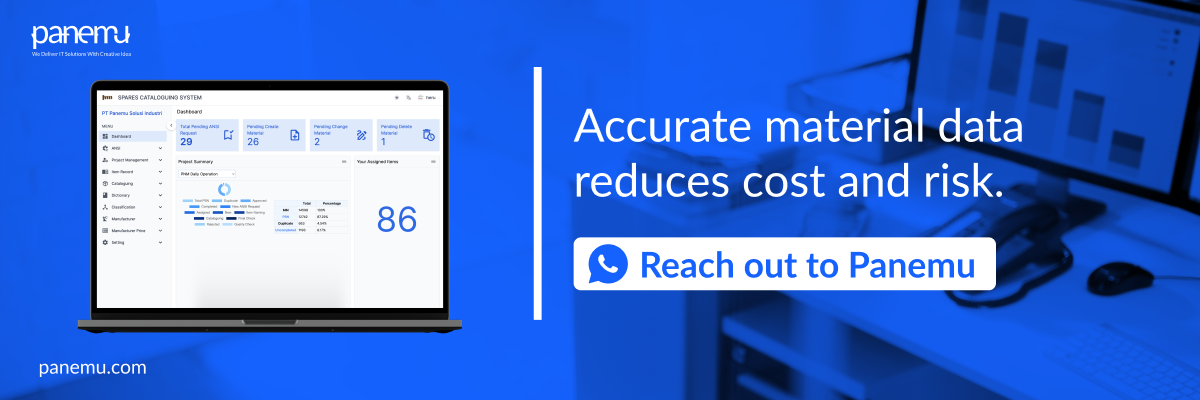
Spares Cataloguing System® (SCS®) provides a structured, standards-based approach to managing the full lifecycle of material data, from creation and maintenance to controlled phase-out. By strengthening Management Master Data governance, SCS® enables organizations to maintain clarity, control, and confidence as their material master evolves.
Learn how SCS® supports material data lifecycle management at panemu.com/scs and explore its key features at panemu.com/scs-key-feature.
Control the lifecycle. Reduce complexity. Let your material data support operations, not burden them.