A Question for Every Supply Chain Leader Who Has Stared at a Delayed PO
How long does it actually take to get an MRO spare part from requisition to receipt?
Not the number in your system. Not the contractual lead time your supplier agreed to. The real number — the one that includes the days your buyer spent going back to the requisitioner to clarify what they actually need. The days the supplier spent emailing to ask whether "VALVE, GATE, 4 INCH" means ANSI 150 or ANSI 300, carbon steel or stainless, flanged or threaded. The days the warehouse spent returning the wrong item because the description was ambiguous enough to be interpreted two ways.
Add those days up. In most asset-intensive operations, they represent somewhere between 20% and 30% of your total procurement cycle time. Not because your logistics are slow. Not because your suppliers are unreliable. Because the specification that left your ERP was not clear enough for anyone to act on without asking questions first.
That is non-value-added time. It does not move parts closer to the plant. It does not reduce cost. It does not improve availability. It is pure friction — and it sits invisibly inside a lead time metric that everyone reports but nobody dissects.
If you run a supply chain where equipment uptime depends on getting the right part to the right place at the right time, that friction is not a minor inefficiency. It is a structural vulnerability. And it has a specific, fixable root cause.

Anatomy of a Lead Time Nobody Measures Honestly
Where the days actually go — and why your dashboard does not show it
Ask your procurement team to break down the lifecycle of an average MRO purchase order. Not a strategic category buy. An everyday replenishment order for a maintenance spare part. The kind your organization processes hundreds or thousands of times per month.
The timeline typically looks something like this:
Phase | What Happens | Typical Duration |
Requisition creation | Maintenance planner identifies need, searches ERP for the part, creates requisition | 1–2 days |
Buyer review and clarification | Buyer reviews the requisition, finds description incomplete or ambiguous, contacts the requisitioner for clarification | 1–3 days |
Supplier quoting | Buyer sends RFQ to supplier; supplier reviews description, requests additional specification details | 2–5 days |
Spec clarification loop | Buyer goes back to requisitioner or engineering for missing attributes, relays to supplier, awaits revised quote | 2–7 days |
PO issuance | Buyer issues PO once spec is confirmed and quote accepted | 1 day |
Supplier fulfilment and delivery | Supplier picks, packs, ships | Varies by item |
Goods receipt and verification | Warehouse receives, checks against PO description | 1 day |
Look at the middle of that timeline. The buyer-requisitioner-supplier clarification loop — phases two through four — is where days vanish without producing any forward movement. The part is not being manufactured during those days. It is not being shipped. It is sitting in an email thread while three parties try to agree on what, exactly, was ordered.
And when the clarification fails — when the supplier interprets the vague description as best they can and ships what they think is correct — the part arrives wrong. Now add return processing, re-ordering, and a second fulfilment cycle. Your 14-day lead time just became 28 days. Your maintenance team is still waiting. Your production schedule is absorbing the delay.
None of this shows up in your lead time dashboard as a data quality problem. It shows up as "supplier delivery performance" or "procurement cycle time." The symptom gets measured. The cause stays hidden.
The Root Cause Is in the Material Master — Not the Supply Chain
Why your suppliers keep asking questions you should not have to answer
Every specification clarification request from a supplier is a signal. It is telling you that the material description your ERP sent out was not sufficient for someone in the supply chain to act on with confidence.
The reasons are consistent across industries:
Vague descriptions. "PUMP, CENTRIFUGAL" tells a supplier the category. It does not tell them the flow rate, head pressure, inlet diameter, material of construction, seal type, or motor specification they need to select the correct unit. The description occupies a field in the ERP. It does not communicate a specification.
Missing attributes. A BEARING record should carry bore size, outer diameter, width, speed rating, seal type, and manufacturer series number. In many enterprise material masters, it carries a description like "BEARING, BALL, SKF" and a part number that may or may not be current. The supplier receives this and must decide whether to guess, call, or email — all of which add days.
Inconsistent naming. The same item described as "GASKET, SPIRAL WOUND, 4IN, 150#, SS316" in one plant and "S/W GSKT 4 ANSI150 316SS" in another creates confusion not just for suppliers, but for your own procurement team trying to consolidate demand or identify approved alternatives.
Outdated or incorrect manufacturer references. Part numbers change. Manufacturers discontinue lines. Cross-references expire. When a PO carries an obsolete part number with an insufficient description, the supplier has no reliable path to the correct item without a clarification cycle.
These are not supplier problems. They are data problems. And they originate in a material master that was never standardized — where records were created by different people, in different plants, at different times, with no enforced structure for how items should be described.
Your suppliers are not slow. Your descriptions are incomplete. And every incomplete description converts directly into lost days.
What Changes When the Description Is Right the First Time
The compounding effect of specifications that need no clarification
Picture a different version of that procurement timeline. Same part. Same supplier. Same buyer. But this time, the material description in the ERP reads:
BEARING, BALL, DEEP GROOVE, BORE 25MM, OD 52MM, WIDTH 15MM, SEALED, SPEED RATING 11000RPM, SKF 6205-2RS1
The requisitioner does not need to add context. The buyer does not need to clarify. The supplier does not need to ask questions. They read the description, identify the item, confirm availability, and ship.
The clarification loop — those 3 to 7 days of emails, calls, and waiting — is eliminated. Not reduced. Eliminated.
Now multiply that across every purchase order your organization processes in a month. If your operation issues 500 MRO purchase orders per month and each one carries an average of 2 days of clarification overhead, that is 1,000 person-days of non-value-added activity per month. Even cutting that in half represents a step-change in procurement throughput.
But the impact does not stop at lead time:
Fewer wrong deliveries. When the description is precise, the supplier ships the right item. Returns, reorders, and double-handling — all of which consume warehouse labour, transport cost, and production patience — decrease.
Faster emergency fulfilment. When a critical part is needed urgently, every hour matters. A standardized description means the supplier can act immediately. An ambiguous one means the emergency itself gets delayed by clarification.
Stronger supplier relationships. Suppliers prefer customers who make it easy to do business. Clear, standardized specs reduce the supplier's internal cost-to-serve and error rate, which translates into better pricing, priority allocation, and willingness to hold consignment stock.
More reliable planning. When lead times are predictable — because the clarification variable has been removed — your planning team can set safety stock levels with confidence rather than padding for uncertainty.

SCS® Builds the Description That Eliminates the Loop
How Spares Cataloguing System® standardizes what your ERP sends to the market
The Spares Cataloguing System® (SCS®) from Panemu exists to solve precisely this problem. It is a material data standardization platform designed specifically for MRO spare parts in asset-intensive industries — mining, oil and gas, power generation, manufacturing — where the material master is the foundation of the supply chain.
Here is what SCS® does to the material descriptions your suppliers receive:
Structured attribute templates. SCS® assigns an attribute template to every item based on its classification. A VALVE gets the attributes a valve needs — type, size, pressure class, material, connection type, manufacturer. A BEARING gets the attributes a bearing needs. The template is not optional. It is enforced by the system, ensuring completeness before the record is approved.
Dictionary-driven naming. SCS® maintains a controlled dictionary of item names using the Noun-Modifier structure — an internationally recognized convention for technical material description. "BEARING, BALL, DEEP GROOVE" — not "ball brg" or "BRNG-BALL" or "SKF bearing." Consistency across every record means consistency in every purchase order.
Auto-generated short and long descriptions. Using standardized abbreviations, SCS® generates both a short description (for ERP fields with character limits) and a long description (for purchase orders and supplier communications). Both are derived from the same structured data, so they are always aligned.
Duplicate screening. Before any new record is created, SCS® screens it against existing records to prevent the same item from entering the master data under a different name or number. Fewer duplicates means fewer versions of the truth — which means fewer conflicting descriptions reaching the market.
Classification to international standards. SCS® classifies items using NATO Supply Classification, UNSPSC, or eCl@ss, providing a shared language between your organization and your suppliers. When both parties are operating on the same classification framework, the room for misinterpretation shrinks.
The result is a material master where every record is complete, consistent, and clear enough that a supplier can act on it without asking a single question. That is not a data quality aspiration. It is an operational specification for supply chain speed.
The Supply Chain GM's Calculation
What this means for your operation in numbers you already track
You do not need to take this on faith. You can test it against your own metrics.
Pull the last 90 days of MRO purchase orders. For each PO, identify how many required at least one round of specification clarification between buyer, requisitioner, and supplier. Estimate the average number of days each clarification cycle added to the overall lead time.
If your operation looks like most asset-intensive enterprises, you will find that somewhere between 20% and 40% of your POs triggered at least one clarification loop, and each loop added 2 to 5 working days.
Now model the removal of that loop. Not through faster email response times. Not through better supplier portals. Through descriptions that do not require clarification in the first place.
The lead time reduction is real. The cost reduction — in fewer wrong deliveries, fewer emergency reorders, fewer hours of buyer-supplier back-and-forth — compounds alongside it. And the improvement in equipment availability, because the right part arrives days sooner, flows directly to your plant's operational performance.
This is not a procurement initiative. It is a supply chain performance initiative that happens to start with the material master.
Why This Has Not Been Fixed Before
And what is different about fixing it with SCS®
If the problem is this visible and the impact this measurable, why does it persist?
Because in most organizations, material data is nobody's primary responsibility. Procurement uses it but does not own it. Maintenance creates it under time pressure. IT manages the system it lives in but not the content. Supply chain depends on it but has no mechanism to standardize it.
One-time data cleanup projects address the backlog but do not prevent new bad data from entering the system. Within months, the same inconsistencies return because the record creation process has not changed.
SCS® breaks this cycle because it is not a cleanup tool. It is a cataloguing system — a governed workflow that enforces standardization at the point of record creation. Every new material record passes through dictionary validation, attribute completeness checks, and duplicate screening before it enters the master data. The system does not rely on individual discipline. It embeds data quality into the process itself.
And because SCS® is supported by Panemu's professional cataloguing team — with direct experience across mining, oil and gas, power generation, and manufacturing — the existing backlog of unstandardized records can be addressed in parallel, without pulling your internal teams away from operations.
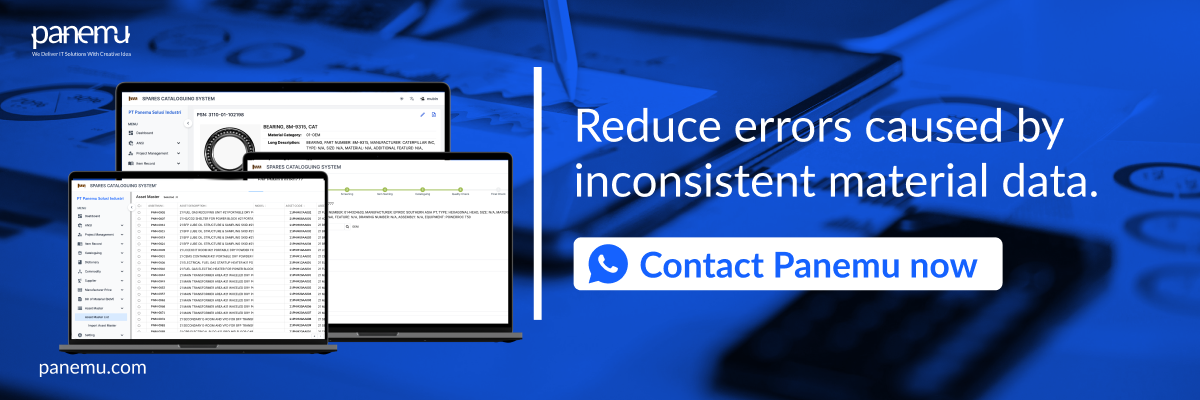
Your Supply Chain Is Only as Fast as Your Slowest Description
The days lost to specification clarification do not appear on any Pareto chart. They are buried inside lead time metrics, averaged away in monthly reports, absorbed by buffer stock that exists specifically to compensate for the unpredictability they create.
But they are real. They cost money. They delay maintenance. They frustrate your buyers, your suppliers, and the planners who depend on both.
Spares Cataloguing System® (SCS®) removes them — not by making the clarification process faster, but by making it unnecessary. Standardized descriptions. Complete attributes. Consistent naming. International classification. Specifications that a supplier can act on immediately, without picking up the phone.
The result is not a marginal improvement. It is the elimination of an entire category of waste from your procurement cycle.
The Right Part. The First Time. Days Sooner.
The Panemu team is ready to walk through your material master data, identify where description gaps are generating clarification cycles, and show you exactly how SCS® standardization translates into lead time reduction for your operation.
Your supply chain. Your data. A concrete path to faster, cleaner procurement.
Fill out the consultation form Here.
Panemu — Committed to providing the best practice of technical solutions for your organization.