If you're a Supply Chain GM and someone asked you right now how many vendors your organisation actually transacts with in a typical quarter, you would have to guess — because the number in your ERP is almost certainly wrong by a factor of 5 to 6. Your vendor master shows 5,000 active vendors. The reality is closer to 800–1,000. Everything else is duplicate records, dormant entities, typo creations, and ghost vendors nobody has dared deactivate for fear of breaking a process nobody remembers. This isn't a cosmetic problem — it's the reason your strategic sourcing team consolidates vendors at 30% of the leverage they should command, your spend analytics directionally mislead procurement leadership, and your vendor management workload is two to three times what it needs to be. Panemu's Cataloguing Service includes vendor master cleansing as a core deliverable — and right now, we're offering a free audit on a 1,000-vendor sample to prove the gap in your data before you commit to anything else. Engage now — this offer is capped per quarter.
The Bloat Is Worse Than You Think — The Real Distribution
Every supply chain leader running a large organisation knows the vendor master is dirty. What most don't realise is how dirty until someone runs a structured audit.
Panemu's vendor master assessments across mining, oil & gas, power, and heavy manufacturing clients in Indonesia and Southeast Asia consistently surface the same distribution. A vendor master of 5,000 records typically breaks down approximately like this: 800–1,200 vendors are genuinely active — transacting in the trailing 12 months, with valid contracts or recurring POs. 1,500–2,000 are duplicates — the same legal entity created multiple times under different naming conventions. 1,500–2,500 are dormant — vendors that haven't transacted in 24+ months, often defunct, merged, or simply never used after onboarding. A tail of 200–500 records are outright errors — typo creations, test entries that escaped to production, dummy vendors created for one-off transactions.
Translate that into operational reality. When your category manager runs a spend analysis for industrial bearings and sees 47 vendors in the category, the real number after deduplication is probably 12–15. When your contracts team reports they manage 5,000 vendor relationships, the actual relationship count is well under a thousand. When your AP team complains about vendor maintenance workload, half of what they touch is records that should not exist at all.
This is not hypothetical — it is the empirical norm in our portfolio. Every quarter you operate with this bloat, your supply chain organisation pays a tax that compounds. Stop paying it. Engage Panemu's Cataloguing Service now — our Q3 delivery slots are filling, and the longer you wait, the more contracts get renewed against fragmented vendor data that destroys your negotiating leverage.
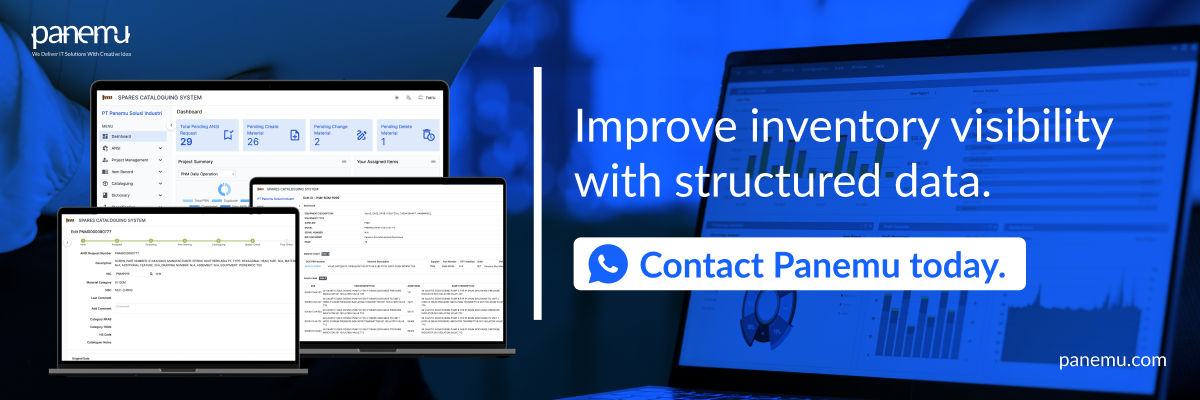
Why Vendor Master Bloat Happens — And Why It Never Self-Corrects
Vendor master bloat is not a failure of any individual on your team. It is the predictable output of how vendor creation and maintenance processes work in most large organisations.
The path of least resistance is to create a new record. When a buyer needs to issue a PO to a vendor that "isn't in the system," the easiest action is to submit a new vendor request. Searching the existing master for variant spellings — "PT ABC Indonesia" versus "ABC Indonesia Pte" versus "ABC IND" versus "ABC Indonesia (PT)" — is friction. The vendor onboarding team, under throughput pressure, approves the new record. Duplication is born.
Deactivation has no clear owner. Activating a vendor is an event with a requester, a justification, and an approver. Deactivating one is rarely anyone's mandate. When a vendor goes dormant — supplier relationship ended, vendor business closed, item no longer sourced — the record stays in the system because no process triggers its removal. Over 5–10 years, dormant records accumulate to outnumber active ones.
Tax IDs, the natural deduplication key, are inconsistently captured. NPWP in Indonesia, ABN in Australia, and equivalent identifiers elsewhere are the unambiguous identifier of a legal entity. Yet in most vendor masters Panemu audits, 30–50% of records have empty, incomplete, or incorrectly formatted tax ID fields. Without the deduplication key, automated matching cannot run reliably.
Mergers, name changes, and corporate restructuring create silent duplicates. When Vendor X is acquired and rebranded, the new entity gets a new vendor record. The old one stays. Spend against the company is now split across two records, both of which look "active" because both received POs within the trailing year.
ERP migrations preserve the bloat. Every ERP migration that does not include a structured vendor master cleansing as a parallel workstream carries the legacy bloat into the new system — usually with new categorisation errors layered on top, because the migration team didn't have the domain expertise to map vendors to the new classification taxonomy correctly.
None of these mechanisms self-correct. Without a deliberate cleansing programme, vendor masters monotonically degrade. The longer you wait to address it, the larger the cleanup — and the more strategic value is lost in the interim.
The Real Cost — What Bloated Vendor Master Steals From Your Organisation
The damage isn't theoretical. Let me make it concrete in the language a Supply Chain GM uses in board reports.
Strategic sourcing leverage is shredded by duplication. When you walk into a contract negotiation with PT ABC Indonesia and the supplier's account team knows your group's actual spend across all their entities is USD 8M annually — but your own analytics show three separate vendor records totalling USD 5.2M, USD 1.4M, and USD 1.6M — you negotiate as a USD 5.2M customer and lose the leverage of the consolidated number. Multiply this dynamic across your top 100 suppliers and the leverage loss is staggering. Panemu's clients routinely identify 8–15% category cost reduction opportunities just from accurate spend consolidation, without negotiating anything new.
Spend analytics directionally mislead leadership. Your CFO asks for top 20 vendors by spend. The list comes back fragmented — the actual top 5 suppliers are scattered across positions 3, 7, 11, 14, and 19 in the report. Strategic decisions about supplier risk, category concentration, and consolidation targets are made on this fragmented view. Some of those decisions are wrong.
Vendor management workload is inflated. Your onboarding and maintenance team processes thousands of records that should not exist. Onboarding teams duplicate-create for the 1,247th time because nobody has fixed the search experience. AP teams reconcile against records that haven't transacted in five years. Compliance teams chase tax certificates from dormant vendors for audit purposes. The fully-loaded cost of this overhead in a mid-sized supply chain organisation typically runs USD 200K–600K annually — pure waste.
Risk management blind spots multiply. When the same physical supplier exists under three records, your supplier risk system tracks each as a separate counterparty. Concentration limits don't catch genuine concentration. Sanctions screening runs three times against the same entity, increasing false positives. Performance KPIs are split across records, hiding underperformance.
Procurement transformation projects stall on bad foundations. Trying to deploy a supplier portal, e-procurement platform, or supplier risk tool on top of a 5,000-record vendor master where 4,000 records are noise produces predictable results — the new system inherits the noise, user adoption suffers because the data feels unreliable, and the transformation project quietly underdelivers.
Every one of these costs is recoverable. The recovery starts with one disciplined cleansing programme, executed by a team that combines deduplication methodology with domain expertise and tax-ID-anchored matching. That is exactly what Panemu's Cataloguing Service is built to deliver.
How Panemu's Cataloguing Service Cleanses Vendor Master — The Method
Vendor master cleansing is not a one-off data exercise — it is a methodology applied at scale, embedded in our broader Cataloguing Service. Here is what we actually do, in the order we do it.
Tax-ID-anchored deduplication. We extract your full vendor master and run NPWP/ABN/equivalent identifier matching across every record. Records with the same tax ID are clustered as candidate duplicates. Where tax IDs are missing or malformed, we apply secondary matching on legal entity name normalisation, registered address, bank account, and contact information. The output is a candidate duplicate cluster list, ranked by confidence.
Domain-validated merging. Candidate duplicates are reviewed by our cataloguing specialists who understand the difference between a true duplicate (same legal entity, two records) and a related-but-distinct entity (parent company versus subsidiary, two divisions of the same group). The merging plan is documented record-by-record, with the surviving master record identified and the records to be deactivated mapped against it.
Activation status review. Every vendor record is evaluated against transaction history. Vendors with zero transactions in the trailing 24 months are flagged for deactivation, with exceptions handled for known low-frequency strategic vendors (insurance, specialised consultants, regulatory bodies). The deactivation list is reviewed with your category managers before execution — nothing gets deactivated without business validation.
Classification standardisation. Active vendors are classified against a consistent taxonomy — UNSPSC for spend categorisation, internal category structures for sourcing alignment, criticality tiers for risk management. This is where domain expertise matters: classifying a vendor as "industrial services" versus "engineering consulting" versus "EPC contractor" requires understanding of what they actually deliver to your business, not keyword matching on their company name.
Attribute enrichment. Missing critical attributes — payment terms, default currency, tax registration, bank verification status, ESG flags, certification records — are flagged and enriched where data is available. This converts the cleansed vendor master into a working operational asset, not just a deduplicated list.
Governance handoff. The cleansing engagement concludes with a governance framework: vendor creation workflows that prevent the bloat from re-emerging, deduplication checks at the point of new vendor request, mandatory tax ID validation, and periodic dormancy review cycles. Without this handoff, the master will degrade again within 18 months.
This is the full lifecycle Panemu delivers. It is not a slide deck. It is operational cleansing with measurable before-and-after metrics — and we contractually commit to those metrics.
Use Cases — How Panemu Clients Recovered Their Vendor Master
The pattern is consistent across asset-intensive sectors, with industry-specific nuances that demonstrate the methodology operates against real procurement complexity.
Mining operations. Large mining clients including Merdeka Copper Gold engage Panemu to cleanse vendor masters that have accumulated over a decade-plus of operation. Typical engagements take 4,000–6,000 vendor records to 900–1,500 active canonical records, with consolidated spend analytics that surface category consolidation opportunities running into IDR billions. One mining client recovered USD 14M in identified consolidation opportunities within six months of cleansing completion, realising USD 9.2M of it within the first 18 months.
Power generation. IPP operators like Jawa Satu Power use vendor master cleansing to reconcile vendor populations across multi-plant portfolios where each plant's commissioning brought its own vendor onboarding pattern. Post-cleansing, group-level master agreements with top suppliers achieved unit price improvements averaging 9.8% on addressed category spend.
Oil & gas operators. Upstream operators in the Arrow Energy portfolio recover significant vendor master leverage particularly in services, EPC partner, and specialised equipment supplier categories where vendor naming variations are extreme. Engagements typically surface IDR 20–80 billion in addressable consolidation depending on operation scale.
Heavy manufacturing. Operators like Denso Indonesia use vendor master cleansing to consolidate supplier relationships across production and MRO domains simultaneously. The methodology supports both production component supplier consolidation (where IATF 16949 quality system rigour applies) and MRO supplier rationalisation (where procurement leverage is the primary outcome).
Public infrastructure. Operators like LRT Jakarta engage the service to recover vendor master integrity for safety-critical asset operations, where vendor compliance documentation, performance tracking, and risk management depend on a clean vendor population.
In each case, the engagement is the catalyst that converts vendor master from administrative liability to strategic asset. Without it, the bloat continues compounding quarter after quarter.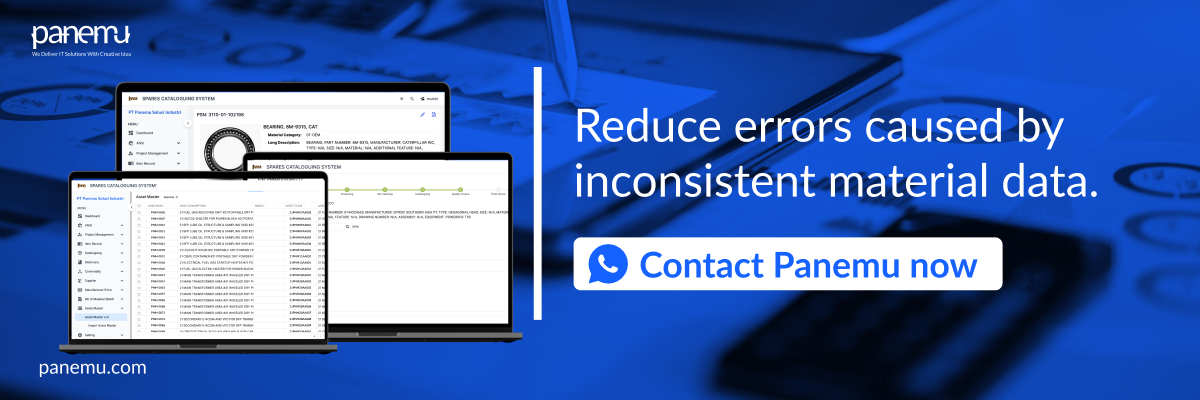
Why You Cannot Solve This Internally — And Why Waiting Is Expensive
Many supply chain leaders read this and think: "We'll assign two analysts to clean it up internally." It almost never works.
Internal teams lack the deduplication tooling. Running 5,000 vendors through structured tax-ID matching, fuzzy name matching, and address normalisation requires purpose-built tools, not Excel pivot tables. Internal projects typically deduplicate 10–15% of true duplicates because manual review hits scale limits.
Internal teams lack the methodology. Cataloguing classification, dormancy review, attribute enrichment — these are practices Panemu has refined across 15+ years of deployments. Internal teams reinvent the methodology poorly and slowly.
Internal teams lack the political distance. Deactivating a vendor record that "belongs" to a senior buyer's relationship is a political conversation. External specialists deliver the recommendation with the credibility of independence — internal analysts get overridden.
Internal projects stall. Without a hard deadline, dedicated resources, and an external accountability partner, vendor master cleansing remains "important but not urgent" forever. Six months become two years. The bloat keeps growing.
And while you wait, every contract that renews gets negotiated against fragmented vendor data. Every category review uses spend analytics that mislead. Every M&A integration adds another layer of bloat on top of the existing layer. Every quarter of delay compounds the eventual cleanup cost and the strategic value foregone.
For organisations seeking sustained governance after the initial cleansing, Panemu's SCS® platform provides the ongoing master data hub infrastructure that prevents re-emergence of the bloat — but the cleansing engagement itself is where the recovery begins.
The window to act is now, not after the next budget cycle.
Claim Your Free 1,000-Vendor Audit — This Quarter Only
Panemu is currently offering a free vendor master audit on a sample of up to 1,000 records for qualifying organisations. The audit is delivered by our cataloguing team within 10 business days of data submission and includes:
A duplication assessment with confidence-ranked clusters showing how many of your records are likely duplicates of one another. A dormancy analysis showing the active versus inactive distribution against your transaction history. An attribute completeness scorecard against critical fields including tax ID, classification, and contact information. A projected post-cleansing master size and a quantified estimate of strategic sourcing consolidation opportunity revealed by the cleansing. A roadmap recommendation for full Cataloguing Service engagement scoped to your specific vendor population.
You will know, with hard numbers from your own data, exactly what your real vendor count is — and what it is costing you to operate with the inflated one.
This audit offer is capped at a limited number of engagements per quarter. Once the slots are taken, the next intake opens the following quarter — and your next contract renewal cycle will run against the bloated master you have today.
To explore the full Panemu Cataloguing Service — vendor master cleansing, material master cleansing, governance frameworks, ERP migration support — and to claim your free 1,000-vendor audit:
👉 Discover Panemu Cataloguing Service and Book Your Free Vendor Master Audit
Contact our team this week. Submit your sample. See your real numbers. Make the strategic sourcing call your organisation has been unable to make for years — because the data finally tells the truth. Panemu's Cataloguing Service is the only specialist methodology engagement in the region engineered for vendor master recovery at enterprise scale. Don't wait for the next budget cycle. Book the audit now.