How long does a perfectly clean ERP database actually stay clean?
Ask that question in a steering committee meeting the week after a cleanup project closes, and you'll get confident answers. Ask it again eight months later, and the tone changes. Because the honest answer, in almost every organisation we've worked with, is: not for long.
The Clock Starts the Moment You Go Live Again
The moment your system starts receiving new material requests, data quality can begin to degrade again. This isn't a failure of the cleanup project. It's a structural fact about how Material Master Data behaves once daily operations resume.
Think about what actually happens on an ordinary working day at an asset-intensive operation. New parts get registered by maintenance planners who need something added quickly. Descriptions get modified by procurement staff correcting a spec. Existing records get retired as equipment is decommissioned. Multiply that across every plant, every shift, every week, and you have a database under constant, low-grade pressure to drift.
Without continuous governance, small variations and duplicate items gradually find their way back into your system. Not because anyone is careless. Because nothing is standing at the gate checking each request against the standard your last cleanup project worked so hard to establish.

This Is Not a Team Effort Problem
Here's the distinction worth making early, because it changes how you diagnose the issue: the problem isn't a lack of effort from your team. Procurement and SCM staff are not failing to care about data quality. They're doing their actual jobs — sourcing, negotiating, keeping operations supplied — and cataloguing discipline competes for their attention against deadlines that feel more immediately urgent.
Supply chains are constantly changing, and so is the data supporting them. New suppliers get onboarded. New equipment gets installed. New spare parts get specified. Every one of these legitimate business events generates a new material request, and every new material request is an opportunity for the standard to be applied loosely, or not at all, if nothing is checking it in real time.
What "Degradation" Actually Looks Like Day to Day
Data decay doesn't arrive as a single dramatic event. It shows up in small, cumulative ways that are individually easy to dismiss:
• Two requesters in different plants create near-identical records for the same physical part, weeks apart, because neither one could confirm the other's record already existed.
• A description gets typed slightly differently than the standard convention under time pressure, and that variant becomes the template the next person copies from search results.
• A material scheduled for retirement stays active in the system because nobody flagged it during a change request review.
Each of these, in isolation, looks trivial. Stacked across months of daily operations, they reconstruct exactly the fragmentation your cleanup project was commissioned to eliminate.
Why the Decay Curve Is Predictable, Not Random
If you plotted data quality against time since your last cleanup, you wouldn't see a flat line followed by a cliff. You'd see a steady, gradual decline that starts almost immediately and accelerates as more requesters, across more sites, interact with the database without a consistent check in place.
This is predictable precisely because it's structural. Every uncontrolled Create request is a new opportunity for drift. Every uncontrolled Change request is a new opportunity for inconsistency. Every uncontrolled Delete request is a new opportunity for orphaned references. None of this requires bad intent — it only requires the absence of a continuous control layer standing between daily requests and your ERP.
A Quick Way to Check Your Own Decay Rate
You don't need a full audit to get a directional sense of where your database currently sits on the decay curve. Pull every material record created in the last ninety days and check a sample against three criteria: does the description follow your naming convention exactly, is the classification correct at every level of your hierarchy, and does a near-duplicate already exist elsewhere in the system.
Compare that sample against records created in the first ninety days after your last cleanup, if you have that data available. In most organisations we've worked with, the gap between the two samples is measurable and growing — not because standards changed, but because the review discipline applied immediately after a cleanup naturally loosens as attention shifts to other priorities.
"We Just Did a Cleanup — Why Would It Already Be Degrading?"
This is a fair objection, and it's worth addressing directly. A cleanup project fixes the records that existed on the day it ran. It says nothing about the records created the following week, the following month, or the following quarter. Those new records were never touched by the cleanup — they're entirely dependent on whatever review discipline exists at the moment they're submitted.
If that discipline is inconsistent, which it usually is without a dedicated screening function, new records start drifting from the standard immediately, even while the records the cleanup touched remain pristine. The database doesn't "re-degrade" so much as it accumulates a growing proportion of never-cleaned, never-screened new data sitting alongside the cleaned historical data — until the two blend together and the original cleanup's benefit becomes hard to distinguish in practice.
The Real Question Isn't "How Long," It's "What Stops the Clock"
Once you accept that clean data has a natural decay curve, the useful question changes. It's no longer "how long will this stay clean" — because the honest answer is always "not indefinitely, on its own." The useful question becomes: what mechanism is actually positioned to intercept degradation before it compounds?
That mechanism has to sit at the point of intake — reviewing every Create, Change, and Delete request against your cataloguing standard before it reaches SAP, Oracle, Maximo, or Odoo. Anything positioned after that point is correction, not prevention, and correction is exactly what your last cleanup project already paid for once.
How Panemu Interrupts the Decay Curve
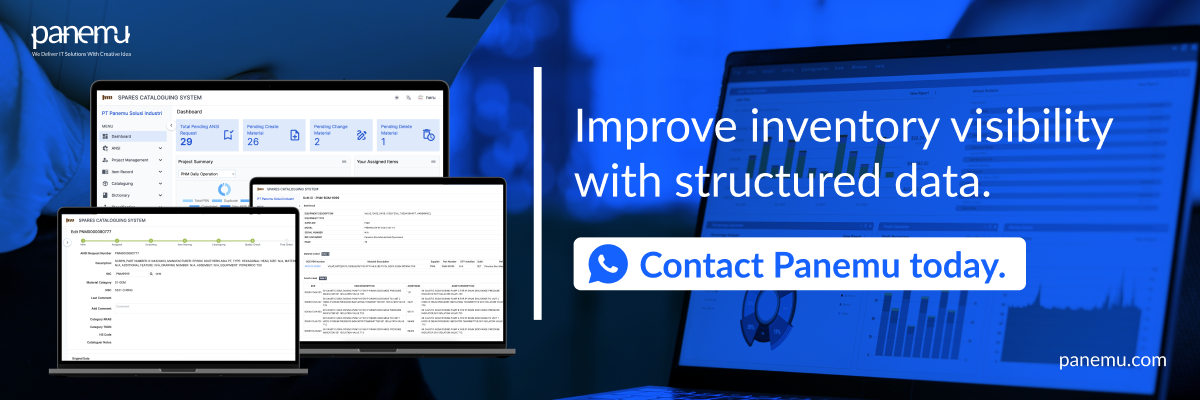
This is the operating model behind Panemu's Daily Cataloguing Service. We combine our SCS®-ANSI module with a dedicated team of experienced cataloguing specialists to manage your daily Create, Change, and Delete requests as part of your ongoing data governance process — not as a periodic intervention, but as a continuous operational layer.
We screen new requests, identify potential duplicates, apply your cataloguing standards, and help ensure new and amended materials meet your data requirements before they enter your ERP. Every request gets the same level of scrutiny, regardless of which plant it came from, who submitted it, or how close to a deadline it was filed.
SCS®-ANSI Module structures this as a formal, auditable request and approval workflow, so your team has full visibility into what was screened, flagged, and approved — turning governance from an assumption into a trackable process.
Experienced cataloguing specialists perform the detailed technical review: duplicate identification, classification accuracy, and nomenclature consistency, applied to every request, every day, at a level of rigor few internal teams have the dedicated bandwidth to sustain indefinitely.
What This Means for Your SCM Team
Your SCM team gets reliable data to support better decisions, while your operations keep moving — without adding internal headcount. That's a meaningful distinction from the alternative, which is either accepting slow degradation between cleanups or building an internal cataloguing function from scratch, with all the hiring, training, and management overhead that involves.
Reliable data isn't just a data quality metric. It's what lets your SCM team trust a search result during an unplanned shutdown, trust an RFQ specification without a supplier clarification round, and trust an inventory count without second-guessing whether it's inflated by duplicate records. Every one of those daily decisions gets faster and more confident when the underlying data hasn't been left to drift since the last cleanup.

From Periodic Project to Continuous Standard
Material Master Data governance shouldn't be a periodic cleanup project. It should be a continuous operational standard — applied the same way, every day, regardless of how much time has passed since the last major initiative.
The organisations that break the decay cycle for good aren't the ones that clean up most aggressively every few years. They're the ones that stop treating "clean" as a temporary state to be re-achieved, and start treating it as a baseline that gets defended daily, one request at a time.
So, back to the opening question. How long does a perfectly clean ERP database actually stay clean? With continuous governance in place, the question stops being relevant — because the database never has the chance to drift far enough to need re-cleaning in the first place.
That reframing is worth sitting with the next time a cleanup project is proposed as the fix. A cleanup answers "how do we get clean again." It has never been able to answer "how do we stay clean," because staying clean was never within its scope to begin with. The two questions require different solutions, and conflating them is exactly how organisations end up commissioning the same cleanup, under a different name, every few years, without ever addressing why the last one didn't hold.
|
Curious how Panemu can help keep your Material Master Data under control? Explore our Daily Cataloguing Service and see how continuous governance replaces the next cleanup project before it's ever needed. Website: panemu.com/scs Email: [email protected] Phone/WhatsApp: +62 812-1590-2011 |