The Diagnosis Everyone Skips
Something is wrong with the ERP. The symptoms are familiar.
Procurement cannot find the right parts. Inventory numbers do not reconcile with what is physically on the shelf. Maintenance planners distrust the system and keep their own spreadsheets. Warehouse teams receive the wrong items because the descriptions in purchase orders are vague or inaccurate. Finance questions the numbers every quarter close.
The natural response — and the expensive one — is to look at the module. Maybe the procurement module needs reconfiguration. Maybe inventory management needs an upgrade. Maybe the maintenance planning module requires additional functionality. Maybe it is time for a full ERP migration.
But here is the question that rarely gets asked early enough: what if the modules are fine, and the data feeding them is not?
Academic research has consistently found that data quality problems become amplified within ERP environments because modules are tightly interconnected — poor data input in one module cascades negatively into others. Gartner's own research has estimated that organizations attribute an average of $15 million per year in losses to poor data quality. And yet, when ERP performance degrades, the first instinct is to tune the software, not audit the data.
For an ERP Director accountable for system performance across procurement, inventory, maintenance, and finance, this distinction is not academic. It is the difference between a six-figure module upgrade that changes nothing and a data assessment that identifies the actual root cause.

The Pattern: Modules Take the Blame for What Data Did
How material master problems disguise themselves as system failures
An ERP system is a logic engine. It processes transactions, runs calculations, generates reports, and enforces workflows based on the data it holds. When the outputs are wrong, there are only two possible explanations: the logic is wrong, or the data is wrong.
In mature ERP implementations — where the software has been configured, tested, and running in production for years — the logic is rarely the problem. The modules work as designed. The issue is that they are working with material master records that were never designed to be consistent, complete, or accurate.
Consider what a single material master record carries. It holds the item description, classification codes, unit of measure, manufacturer references, dimensional attributes, approved suppliers, and pricing data. Every module in the ERP touches some subset of this record:
- Procurement relies on descriptions and supplier data to generate purchase orders.
- Inventory relies on classification and unit of measure for stock counting and valuation.
- Maintenance planning relies on part specifications to build work orders and BOMs.
- Finance relies on all of it for cost allocation, budget tracking, and reporting accuracy.
When a material master record is incomplete — missing a manufacturer part number, or carrying a vague description like "VALVE, MISC" — the procurement module does not fail in a technical sense. It generates a purchase order with an incomplete specification. The supplier interprets it as best they can. The wrong part arrives. Maintenance rejects it. An emergency reorder follows at premium cost. The inventory module now shows stock for a part nobody needs.
At no point did any module malfunction. The modules did exactly what they were told to do. The problem was what they were told.
The Numbers You Have Never Seen
Quantifying the data problem your ERP reports cannot show you
Here is the challenge for any ERP Director trying to diagnose performance issues: the ERP itself cannot tell you what is wrong with its own data.
Your system can report that a purchase order was created, that a goods receipt was posted, that inventory was adjusted. What it cannot report is that the material master record behind that transaction was incomplete, duplicated, or incorrectly classified — because from the system's perspective, the record is valid. It has a number. It has a description. It exists. The system does not know that the same physical item exists under three other numbers with three different descriptions in three other plants.
This is the blind spot. And it is why ERP performance issues tied to data quality persist through module upgrades, system reconfigurations, and even full ERP migrations. You can move bad data into a new system — it is still bad data.
What you need, before making any decision about module tuning or system investment, is a clear answer to three questions:
- How many material master records are incomplete? Records missing critical fields — manufacturer part number, material grade, dimensional attributes, proper unit of measure — that cause downstream processing errors.
- How many material master records are duplicates? The same physical item existing under multiple stock-keeping units because different teams created records independently using different naming conventions.
- How many material master records are incorrectly classified? Items assigned to the wrong commodity group or material category, making spend analysis unreliable and category management impossible.
Your ERP cannot answer these questions. It was not designed to. But a purpose-built material data assessment can.
What an SCS® Assessment Actually Reveals
A diagnostic built for the problem your ERP was not designed to detect
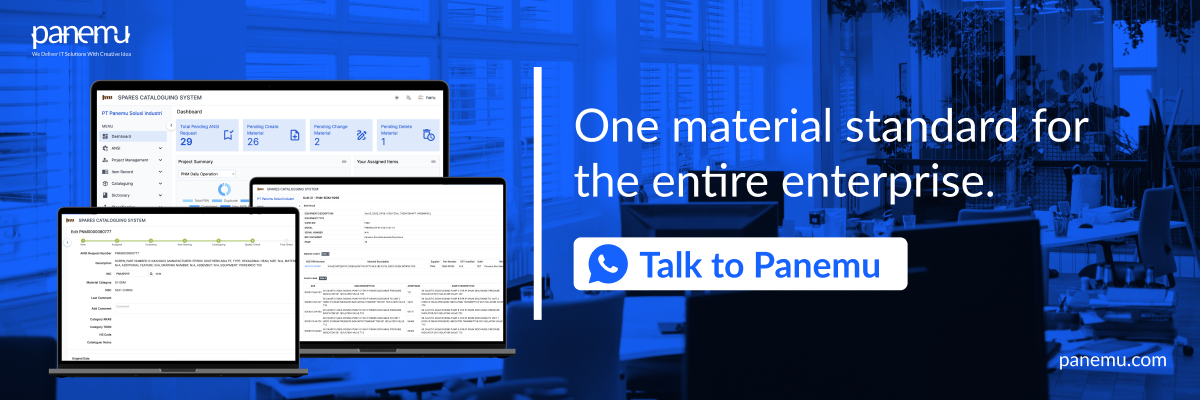
The Spares Cataloguing System® (SCS®) from Panemu is, at its core, a material data standardization platform. But before any standardization begins, SCS® offers something that most ERP Directors have never had access to: a structured, quantified assessment of material master data quality.
This is not a generic data audit. It is an assessment designed specifically for MRO material masters — the most complex, most neglected, and most operationally impactful data set in any asset-intensive ERP environment.
Here is what the assessment produces:
Completeness Analysis. SCS® evaluates each material master record against the attribute template appropriate for its item type. A FLANGE record should carry inner diameter, outer diameter, pressure rating, material grade, and flange standard. A BEARING record should carry bore size, outer diameter, width, speed rating, and manufacturer series. The assessment identifies every record that falls short — and quantifies the gap across your entire material master.
Duplicate Detection. Using its built-in screening engine, SCS® identifies records that describe the same physical item under different identifiers. This is not a simple text match. The system accounts for variations in naming conventions, abbreviation differences, and attribute combinations to surface duplicates that would be invisible to a standard ERP query or even a manual audit.
Classification Accuracy. SCS® validates each record's classification against recognized international standards — NATO Supply Classification, UNSPSC, or eCl@ss — and flags records that are misclassified, unclassified, or assigned to overly generic categories that prevent meaningful spend analysis.
The output is a quantified diagnostic. Not a vague statement that "data quality needs improvement." A specific report that says: of your 47,000 material master records, this percentage are incomplete, this percentage are duplicates, this percentage are incorrectly classified. And here is the module-level impact map — this is what procurement sees, this is what inventory sees, this is what maintenance planning sees.
Why This Changes the Conversation About ERP Investment
From "the module needs upgrading" to "the data needs fixing first"
The strategic value of an SCS® assessment is not the report itself. It is what the report prevents.
Without it, the typical path looks like this:
Module underperforms → Business users complain → ERP team investigates configuration → Vendor recommends upgrade or additional module → Budget is approved → Upgrade is implemented → Same complaints surface within two quarters because the underlying data has not changed.
Research across the ERP industry confirms this pattern. Data collected over the years on ERP implementations has found that roughly half fail the first time. The causes frequently cited include poor data quality, inadequate data migration strategies, and underestimating the role of master data in system performance. Panorama Consulting's analysis found that more than 70% of ERP implementations fail to reach their original business case goals — and data integrity is consistently among the root causes.
With an SCS® assessment, the conversation shifts:
Module underperforms → SCS® assessment quantifies material master data issues → Root cause is identified as data, not software → Data standardization is executed through SCS® → Module performance improves without upgrade → Budget is preserved for initiatives that actually require it.
For an ERP Director, this is not just a cost savings argument. It is a credibility argument. When you can walk into a steering committee and demonstrate — with data — that the ERP performance issue is traceable to 14,000 incomplete records and 6,200 duplicates rather than a module deficiency, you change the nature of the decision. You move from reactive system spending to targeted data investment.
After the Assessment: What SCS® Does With the Findings
From diagnosis to resolution within the same system
An assessment that only identifies problems and leaves you to solve them on your own is an expensive report. What distinguishes SCS® is that it is both the diagnostic tool and the remediation platform.
Once the assessment quantifies the scope of material master data issues, SCS® provides the workflow to resolve them:
- Incomplete records are enriched through SCS®'s attribute mapping engine, which auto-assigns the correct attribute template based on item classification, ensuring every record carries the fields required for its item type.
- Duplicate records are surfaced through the screening engine and can be merged or linked within SCS®, consolidating demand visibility and restoring accurate inventory counts.
- Misclassified records are reclassified using SCS®'s dictionary and classification module, which supports NATO, UNSPSC, eCl@ss, and custom enterprise taxonomies.
- Standardized records are exported back into your ERP through SCS®'s scheduled export capability — on your timeline, in your format, aligned with your data governance process.
And critically, SCS® does not just clean the existing data. It prevents the same problems from recurring. Every new material record created through SCS® is subjected to duplicate screening, attribute validation, and classification enforcement before it enters the master data. The system embeds data quality governance into the record creation process itself — which is why organizations that use SCS® see sustained improvement rather than the cyclical degradation that follows one-time cleanup projects.
The Assessment as a Strategic Decision Tool
What it tells your CFO, your CIO, and your board
An SCS® assessment produces more than a data quality report. It produces the evidence base for three strategic conversations:
With your CFO: "Before we approve the proposed module upgrade budget, here is a quantified analysis showing that the root cause of procurement and inventory module issues is material master data quality. Fixing the data costs a fraction of the upgrade and addresses the actual problem."
With your CIO: "Our ERP performance issues are not a platform limitation. They are a data governance gap. Here is the specific scope — number of incomplete, duplicate, and misclassified records — and a remediation path that integrates with our existing system architecture."
With your board: "We have identified a structural data quality issue that has been degrading ERP performance across procurement, inventory, and maintenance. Rather than investing in system replacement, we are addressing the root cause through a targeted data standardization initiative with measurable outcomes."
These are conversations grounded in evidence, not assumptions. And they position the ERP function as a strategic asset manager rather than a cost center requesting more budget.

Stop Treating Symptoms. Start Measuring the Disease.
Every asset-intensive organization running an ERP system has material master data problems. The only variable is whether you know their exact scope — or whether you are making investment decisions without that information.
If your procurement module is generating complaints, if your inventory numbers do not reconcile, if your maintenance planners have lost trust in the system — the answer may not be a module upgrade. It may be 15,000 material master records that nobody has properly assessed.
Spares Cataloguing System® (SCS®) offers that assessment. Quantified. Specific. Actionable. And backed by the same system that resolves the issues it finds — with professional cataloguing support, international data quality standards (ISO 8000, NATO Codification System, UNSPSC), and seamless integration back into your ERP.
The first step is knowing the number. Everything else follows from there.
Find Out What Your Material Master Is Actually Costing You.
The Panemu team will conduct a structured assessment of your MRO material master data — identifying exactly how many records are incomplete, duplicated, or incorrectly classified, and mapping the impact to the ERP modules experiencing performance issues.
No assumptions. No generic benchmarks. Your data. Your numbers. Your answer.
Fill out the consultation form Here.
Panemu — Committed to providing the best practice of technical solutions for your organization.