Every supply chain—especially in the military domain—relies on structure and categorization. Without a shared language to classify goods, communication between allied forces would falter, procurement would slow, and mission readiness would be compromised. The NATO Supply Classification (NSC) provides that unifying structure, ensuring that items are grouped logically by type and function, creating clarity across all levels of military logistics.
The Essence of NATO Supply Classification
The NATO Supply Classification (NSC) is the system used to group and categorize items based on their nature, characteristics, and intended function. It is the foundation of the NATO Codification System, providing the first four digits of every NATO Stock Number (NSN). Through NSC, items are not merely listed—they are systematically organized into families and groups that make sense across procurement, warehousing, and operational deployment.
- Structured Categorization
NSC classifies all items into a coherent family-tree structure, from broad categories down to detailed sub-groups. - Universal Consistency
NSC ensures that whether a part is sourced in France, Canada, or Poland, its classification code points to the same family of items. - Functional Clarity
Each NSC conveys not just what the item is, but also its general application domain—making it easier for logistics officers to align material requirements with operational needs.

Structural Principles of NSC
The NSC operates under clear and universal rules that ensure global uniformity:
- Four-Digit Format
The NSC is always expressed as four digits, where the first two digits define the Group, and the next two digits define the Class within that group. - Group and Class Hierarchy
The first two digits (Group) define broad categories such as Weapons (10), Food (89), or Medical Equipment (65). The second two digits (Class) specify narrower divisions within that group. - Neutral and Stable Identification
Like the broader NATO codification philosophy, NSCs are non-intelligent identifiers—they point to families and classes without embedding excessive descriptive meaning that could change over time.
Functional Use Cases of NSC
The NATO Supply Classification plays a decisive role in multiple aspects of military logistics:
- Procurement Standardization
By grouping similar items under one NSC, procurement officers can compare suppliers and negotiate contracts with greater precision. - Inventory Segmentation
Warehouses use NSC to organize shelves and stock records, ensuring items are stored in a logical sequence that supports faster retrieval. - Operational Readiness
When planning deployments, logisticians can request entire NSC families (e.g., medical kits or vehicle spare parts) without needing to specify each individual NSN. - International Coordination
During joint missions, allied forces can align supply categories quickly by referencing NSC codes, avoiding confusion caused by language differences.
Key Components of NSC
The NATO Supply Classification is composed of structured elements:
- Group (First Two Digits)
Defines the broad family of items. - Class (Second Two Digits)
Further refines the item’s classification within the group. - NSC–NSN Relationship
The NSC always provides the opening four digits of a NATO Stock Number, serving as its classification anchor.
Examples of NATO Supply Classification Codes
To understand NSC in practice, here are examples of real classification codes:
- Group 10 – Weapons
- Class 10: Guns, through 30mm
- Class 20: Guns, over 30mm up to 75mm
Example NSN:
NSN: 1005-00-073-9421
1005 = NSC → Guns, through 30mm
- Group 23 – Ground Vehicles
- Class 20: Trucks and Utility Vehicles
Example NSN:
NSN: 2320-25-146-3825
2320 = NSC → Trucks, Utility
- Group 65 – Medical and Surgical Equipment
- Class 15: Medical and Surgical Instruments
Example NSN:
NSN: 6515-00-935-7138
6515 = NSC → Medical Instruments
- Group 89 – Subsistence (Food)
- Class 10: Food, Perishable
- Class 15: Food, Non-Perishable
Example NSN:
NSN: 8915-01-123-4567
8915 = NSC → Food, Non-Perishable
Challenges Without NSC
The absence of a shared classification framework would create significant operational risks:
- Nations might duplicate efforts by cataloguing the same items under different headings.
- Procurement teams would struggle to identify comparable items from different suppliers.
- Warehouses would become cluttered and inefficient, with items scattered under inconsistent categories.
- Multinational missions would face delays due to misaligned item categorizations.
Functional Patterns in NSC Application
Several patterns define how NSC is practically applied:
- Hierarchical Inventory Design
Stock records are organized by NSC to create tiered visibility from group to class to item. - Bulk Requisitioning
Units can request items at the NSC level, simplifying large-scale procurement for common categories. - Cross-Reference to Civilian Standards
Some NSCs align closely with international commodity classifications, bridging military and civilian supply chains.
Best Practices in Using NSC
To maximize the benefits of NSC, organizations adopt the following practices:
- Train logistics personnel to understand NSC grouping and classes.
- Use NSC as a primary dimension in cataloguing and ERP systems.
- Audit item groupings regularly to ensure accurate alignment.
- Harmonize NSC data across national inventories to strengthen multinational interoperability.
The Interplay Between NSC and NSN
While the NSC provides categorization, the NSN delivers unique identification. Together, they create a complete picture: NSC tells you what kind of item it is, while NSN tells you which exact item it is. This interplay ensures both functional clarity and operational precision.
Closing Perspective
The NATO Supply Classification is more than a cataloging tool—it is the backbone of item organization within the NATO Codification System. By providing universal categories, NSC ensures that every item, from a single bolt to an armored vehicle, can be placed within a logical and shared framework. This shared structure enables NATO and allied forces to operate as one, supported by a supply chain that speaks a single, unifying language.
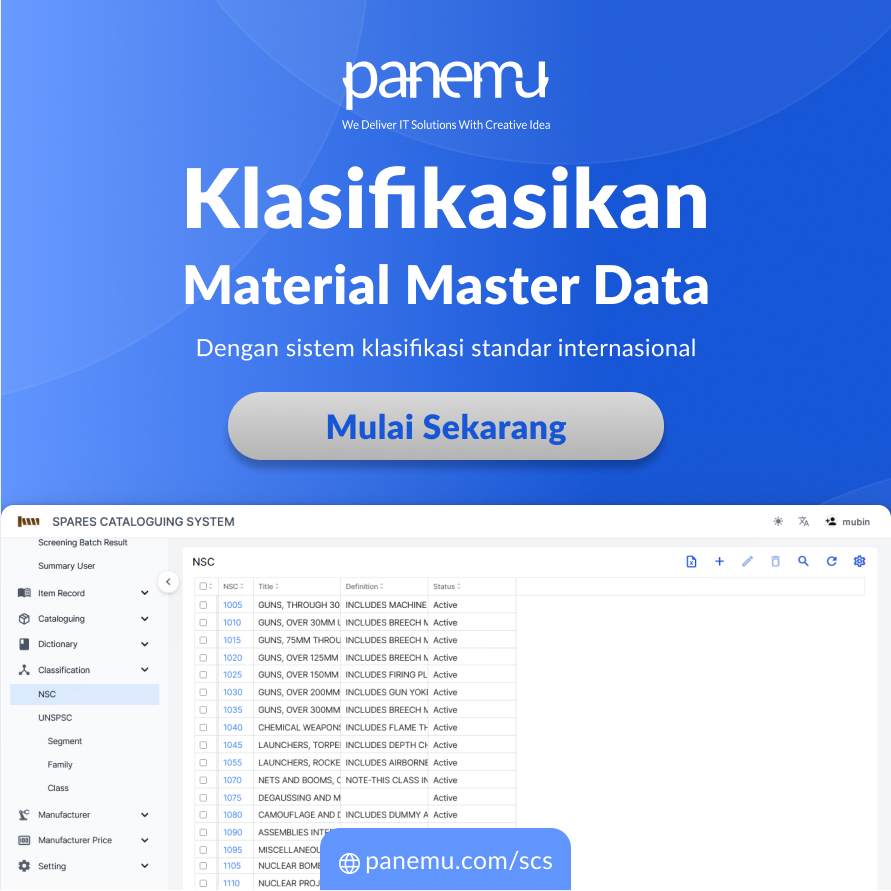
For defense organizations seeking to enhance their cataloguing and classification strategies, services like Panemu Cataloguing Service bring professional expertise in structuring item data effectively. Meanwhile, solutions such as Panemu SCS Key Feature provide advanced tools for classification and standardization, ensuring smooth integration with logistics systems. Leveraging these services is a strategic move toward stronger interoperability, efficient procurement, and reliable mission readiness.