In every enterprise, there is a moment—often subtle—when confidence in the numbers begins to erode.
It happens when two departments present different inventory figures for the same period. When procurement reports cost efficiency, yet finance questions working capital exposure. When operations insists stock is insufficient, but the system indicates surplus.
At that moment, the issue is not performance.
It is alignment.
And alignment does not begin with dashboards or analytics platforms. It begins much deeper—within the structure, governance, and ownership of master data.
Master Data Management (MDM) is frequently positioned as a technical program. In reality, it is a business architecture initiative. When treated as such, it becomes the mechanism that synchronizes operations, procurement, finance, and executive strategy into a single, coherent operating model.
Reframing Master Data: From Technical Asset to Business Infrastructure
Material master data is not static reference information. It is operational DNA.
Every material record influences:
- Inventory valuation
- Procurement consolidation
- Maintenance planning
- Asset reliability analysis
- Working capital calculation
- Risk exposure assessment
When structured properly, it enables precision. When inconsistent, it introduces distortion—often invisible until the impact becomes measurable.
Research from Gartner consistently highlights the financial implications of poor data quality, particularly in large enterprises where inconsistencies multiply across systems and locations. In capital-intensive industries, even small structural weaknesses in master data can scale into significant financial and operational consequences.
The strategic question is no longer whether MDM is necessary.
The question is whether it is positioned as a cross-functional initiative—or confined to system administration.
The True Scope of Master Data Management
Effective MDM operates across functional boundaries. It integrates business logic into data structure, ensuring that material information reflects operational reality.
Below is a simplified view of how master data influences each core function:
Function | Dependency on Master Data | Business Impact |
Operations | Accurate material descriptions, attributes, interchangeability | Reduced downtime risk |
Procurement | Consolidated item codes, standardized specifications | Stronger negotiation leverage |
Finance | Consistent valuation, UoM alignment, obsolescence visibility | Reliable working capital reporting |
Executive Management | Unified definitions across sites | Confident decision-making |
When MDM is siloed within IT, these connections weaken. When governed as a shared responsibility, they strengthen.
Why MDM Initiatives Often Underperform
Many organizations launch MDM projects with strong intent but limited cross-functional integration. The initiative focuses on cleansing data, eliminating duplicates, and standardizing fields. While necessary, these steps are only the beginning.
Common structural gaps include:
- Lack of clearly defined data ownership
- Absence of enterprise-wide taxonomy standards
- No formal governance workflow for new material creation
- Minimal KPI monitoring for data quality
- Limited executive sponsorship
Without these elements, improvement remains temporary. Data gradually reverts to inconsistency as operational pressure increases.
Sustainable MDM requires more than correction—it requires design.
The Structural Pillars of an Integrated MDM Program
An enterprise-grade MDM initiative typically rests on five interdependent pillars:
1. Standardized Data Architecture
A harmonized classification hierarchy, mandatory attribute structure, and controlled vocabulary ensure comparability across sites and systems.
2. Data Cleansing and Normalization
Duplicate elimination, UoM harmonization, and attribute completion create structural consistency.
3. Governance Framework
Defined roles, approval workflows, and accountability mechanisms protect data integrity over time.
4. Cross-Functional Ownership
Operations, procurement, finance, and IT share responsibility rather than deferring to a single department.
5. Continuous Quality Monitoring
KPIs such as duplicate ratio, attribute completeness percentage, and classification accuracy maintain visibility.
Without one of these pillars, alignment weakens.
The Financial and Strategic Impact
When MDM operates as an integrated business initiative, enterprises begin to experience measurable improvements:
- Reduced duplicate materials across sites
- Optimized MRO inventory levels
- Improved service levels without increased stock
- Enhanced supplier consolidation opportunities
- Shorter reporting cycles
- Increased audit readiness
Structured data enables differentiated inventory strategy. It supports segmentation. It improves forecast reliability. It protects working capital without compromising uptime.
This is not theoretical efficiency. It is structural efficiency.
Cultural Alignment: The Often Overlooked Dimension
Technology supports MDM. Governance sustains it. Culture determines whether it survives.
In many enterprises, material creation occurs under operational urgency. A breakdown triggers emergency procurement. A project deadline pressures rapid item registration. Under such circumstances, structure may feel secondary.
Over time, these exceptions accumulate.
An integrated MDM initiative addresses this reality directly by embedding discipline into ERP workflows and aligning incentives across functions. When data quality metrics are visible at management level, compliance increases naturally.
MDM succeeds when data integrity becomes part of operational accountability.
Master Data Management and Digital Transformation
Digital transformation initiatives—predictive analytics, automated replenishment, AI-based optimization—require structured and consistent master data. Without it, algorithms amplify inconsistency rather than insight.
MDM serves as the foundation layer for digital scalability.
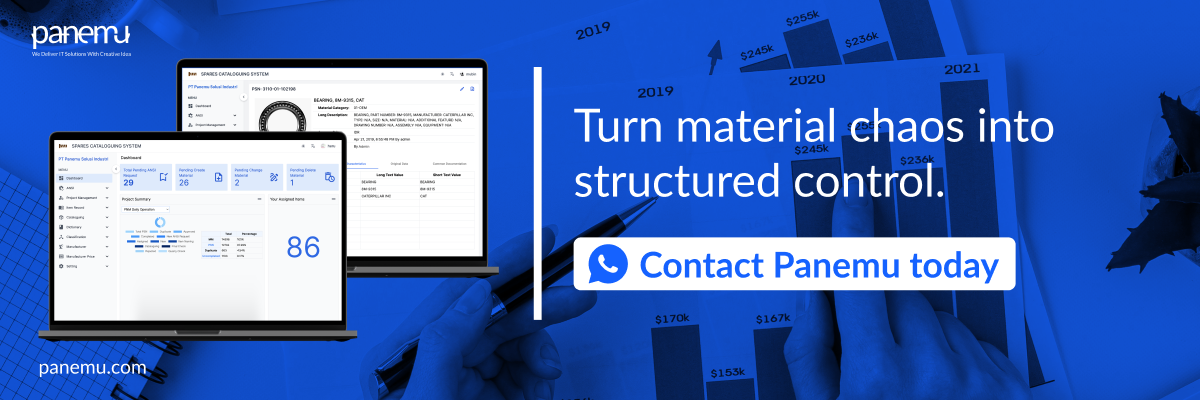
Frameworks such as the Spares Cataloguing System® (SCS®), developed by Panemu, demonstrate how structured, attribute-driven cataloguing strengthens the material master within broader MDM architecture. By embedding classification logic and technical validation into material workflows, such frameworks reinforce cross-functional alignment and long-term integrity.
Digital ambition without disciplined data is fragile.
Digital ambition supported by integrated MDM is scalable.
From Initiative to Institutional Discipline
One of the most decisive shifts in enterprise MDM maturity is transitioning from a temporary project to a permanent governance program.
A project improves historical data.
A program safeguards future data.
Organizations that institutionalize MDM typically establish:
- Executive sponsorship at strategic level
- Cross-functional steering committees
- Defined data quality KPIs
- Periodic maturity assessments
- Formalized data ownership roles
This structure elevates MDM from operational maintenance to strategic enabler.
A Strategic Reflection for Enterprise Leaders
Every strategic decision depends on information integrity. Expansion, acquisition, digitalization, cost optimization—all rely on consistent definitions and reliable master data.
If material master data remains fragmented, decision confidence remains conditional.
If master data is governed as a unified business asset, enterprise alignment strengthens.
The difference is subtle in appearance, yet profound in impact.
This is an appropriate time to evaluate:
- Is Master Data Management positioned as a cross-functional initiative?
- Are taxonomy and attribute standards harmonized across sites?
- Is governance embedded into material creation workflows?
- Are data quality metrics visible at executive level?
If alignment gaps exist, the opportunity is equally significant.
Master Data Management is not about controlling data. It is about enabling coherence across the enterprise.
And coherence is a strategic advantage.
Initiate a Strategic Executive Dialogue Today. Elevate Master Data Management into an integrated business discipline—and ensure every operational, financial, and strategic decision rests on structured, trusted, and aligned data.