Your SCM director just asked for two more cataloguers in next year's budget. Finance wants to know why headcount keeps climbing when transaction volume, not team size, is the actual problem. Both of them are right—and both of them are asking the wrong question.
The Operational Necessity Nobody Budgets For
For modern, asset-heavy enterprises, data governance is no longer a luxury—it is an operational necessity, on par with safety compliance or maintenance planning. Yet establishing an internal department dedicated solely to maintaining the integrity of Material Master Data is incredibly difficult in practice.
It requires recruiting highly specialized cataloguers who understand both industrial classification standards and your specific asset base. It requires investing in continuous training as taxonomies evolve and new equipment enters service. And it requires managing key-person risk, all while facing constant pressure to control corporate overhead and headcount—two priorities that pull directly against each other.
Most SCM leaders discover this tension the hard way: the moment they commit to a genuine governance standard, they realize enforcing it consistently requires more specialized capacity than their current structure was ever designed to carry.

The Operational Cost of Clean Master Data
When an organization decides to enforce strict material master standards, it quickly discovers the sheer volume of day-to-day transactions involved. In an active mine, oil field, or manufacturing plant, there are constant requests to create new codes, modify existing specifications, and flag obsolete records—often numbering in the hundreds per week across a multi-site operation.
If these requests are routed through standard, non-specialist employees, severe operational friction results, and it tends to show up as one of two failure modes. If the SCM team implements slow, complex internal validation rules, procurement cycles stall: purchase requisitions wait for days while incomplete forms are returned to requesters for correction. Conversely, if rules are relaxed to keep operations moving, duplicate and incorrect data flood the database, and the organization is back to the exact problem a cataloguing standard was supposed to prevent.
There is a third failure mode that is easy to overlook until it happens: concentration risk. Cataloguing expertise is highly concentrated by nature—it takes years to build fluency in UNSPSC, eCl@ss, and manufacturer nomenclature across a diverse asset base. If the single employee holding that "cataloguing knowledge" leaves the company, resigns, or is simply on extended leave, the master data function collapses. Backlogs explode, standards drift within weeks, and nobody left on the team has the context to catch it.
Why "Just Hire More" Doesn't Solve It
The instinctive response to rising request volume is to add headcount. But cataloguing headcount does not scale cleanly with transaction volume the way, say, warehouse labor does. Training a new cataloguer to full productivity takes months, not weeks. Request volume is also rarely steady—it spikes around ERP migrations, plant expansions, and turnaround maintenance windows, then falls back to baseline, leaving a permanently-sized internal team either overstaffed in quiet periods or underwater during peaks.
Permanent headcount also carries permanent cost: salary, benefits, training, management overhead, and succession planning, all of which persist regardless of whether request volume is high or low in a given quarter. For a function that is fundamentally variable in demand, a fixed-cost internal team is structurally mismatched to the problem it's meant to solve.
The Hidden Math of a Growing Backlog
Backlogs in master data requests behave differently from backlogs in most other operational queues, and that difference is what makes them dangerous. A shipping backlog is visible—orders sit unfulfilled, and someone escalates within days. A cataloguing backlog is invisible by comparison, because the workaround is always available: skip the standard, create the record anyway, fix it later.
"Later" rarely comes. Each skipped validation becomes a new duplicate, a new incomplete attribute set, or a new classification gap that has to be found and corrected eventually, usually during the next full cleansing project, at far higher cost than catching it at intake would have been. A backlog of 500 unvalidated requests is not 500 units of deferred work; it's 500 opportunities for the exact decay pattern that a prior cleansing project was hired to fix in the first place.
This is precisely why understaffed internal cataloguing functions tend to create more long-term cost than they save in the short term. The team looks efficient on a headcount chart while the database quietly reaccumulates the mess a previous project already paid to remove.
Choosing the Right Partner Model
Not every outsourcing arrangement is built for this problem. Generic business process outsourcing (BPO) models are optimized for high-volume, low-complexity data entry—useful for many back-office functions, but poorly suited to cataloguing, which requires genuine technical judgment: recognizing when two part numbers describe the same physical item, or when a specification gap needs to be resolved with the requester before a record can be finalized.
The right partner model combines three things that rarely coexist in a single vendor: cataloguing specialists who understand industrial classification standards, a structured governance platform that enforces the workflow rather than relying on individual diligence, and a service commitment—an SLA—that scales predictably as your request volume changes. Evaluate any outsourced data governance option against those three criteria before committing, regardless of who is proposing it.
The Panemu Solution: Capacity Without Headcount
PT Panemu Solusi Industri's Daily Cataloguing Service solves this operational dilemma by delivering an integrated, expert-led capability that scales to your exact request volume—without adding a single permanent internal headcount.
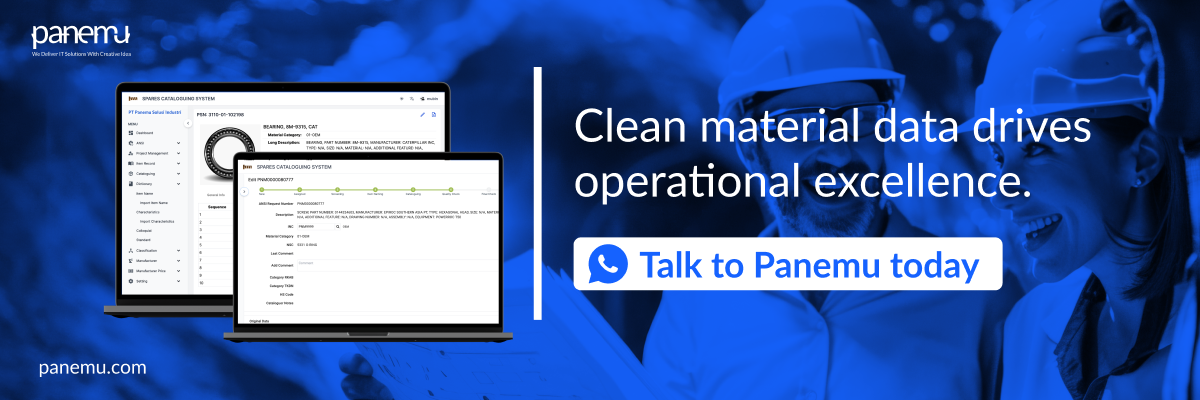
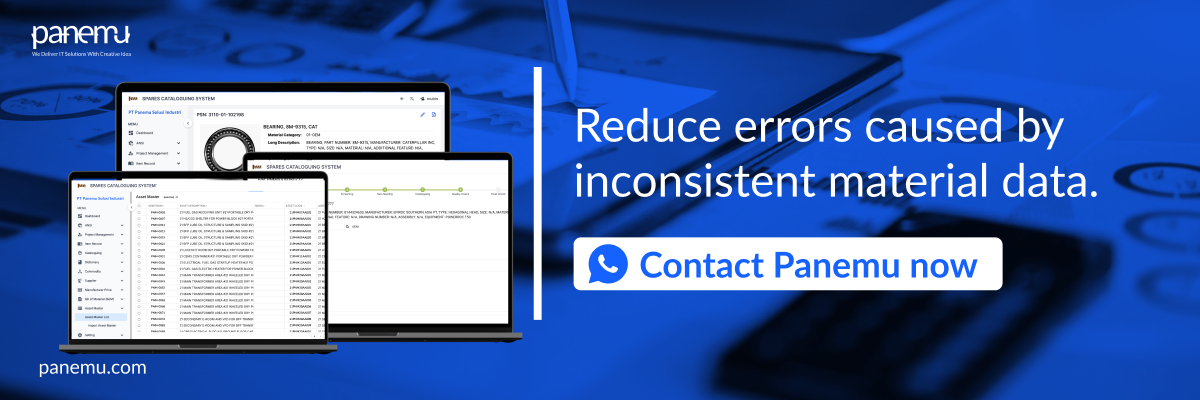
We act as a direct, seamless extension of your master data function, not a disconnected vendor. Your team simply submits Create, Change, and Delete requests through the SCS®-ANSI platform, using the same structured workflow your internal staff would use. Our dedicated, experienced cataloguers handle the rest: interpreting user input, drawings, and manufacturer references, standardizing the descriptions, and validating them against industry taxonomies before anything reaches your ERP.
Because the service scales with volume rather than headcount, a turnaround maintenance event that triples your request queue for three weeks doesn't require an emergency hire—it's simply absorbed by a team already sized for variable demand across multiple clients. When volume falls back to baseline, you're not carrying idle capacity on the payroll either; the cost scales down with it.
Enterprise Business Value and Risk Mitigation
Outsourcing daily cataloguing to PT Panemu Solusi Industri unlocks significant enterprise business value across five critical areas:
• Faster Material Availability — New material codes are processed and validated within strictly defined Service Level Agreements (SLAs), removing SCM bottlenecks and speeding up the requisition cycle from request to posted record.
• Sustained Data Investment — The expensive initial investment in data cleansing is permanently preserved. Database quality is maintained continuously instead of degrading between periodic projects, protecting the ROI of your original cleanup or ERP migration.
• Elimination of Key-Person Risk — Our managed service ensures continuity. You are no longer vulnerable to single-point-of-failure talent risk; our team is scaled, trained, and always available, regardless of individual staff turnover.
• Audit-Ready Governance — Every single CRUD transaction carries a complete audit trail—detailing the documented justification, requester, cataloguer, approver, and exact timestamp, ready for internal or external audit at any time.
• Lower SCM Risk — Accurate, attribute-rich specifications eliminate wrong-part purchases, prevent failed warehouse issues, and ensure operational readiness for planned and unplanned maintenance alike.
You Keep the Authority; We Handle the Workload
Crucially, this service operates entirely inside your existing governance framework, not alongside it or in place of it. Panemu does not take ownership of your data. Your internal team retains full authority to approve or reject drafted records before they are posted to the ERP, at every step in the workflow.
This distinction matters to data owners and compliance teams who are, understandably, cautious about outsourcing anything touching core enterprise systems. The model here is closer to a specialized back-office extension than a third-party data owner: Panemu drafts to standard, your team decides. Nothing reaches SAP, Maximo, or Oracle without your sign-off, and your segregation-of-duties policy stays exactly as it was designed, with an added layer of specialist support rather than a new external dependency.
What Scaling Without Headcount Actually Looks Like
In practice, this means an SCM leader can commit to a governance standard—full duplicate screening, complete attribute enrichment, taxonomy compliance—without first winning a multi-year headcount business case through finance. The service starts at the volume you have today and adjusts as that volume changes, whether that's a new site coming online, a plant expansion, or a seasonal maintenance surge.
For finance, the value is equally direct: cataloguing capacity becomes a variable operating cost tied to actual request volume, rather than a fixed headcount commitment that has to be justified and re-justified every budget cycle regardless of demand.
For the SCM director and finance leader from the opening of this article, that reframes the entire conversation. The question was never "how many cataloguers do we hire." It was "how do we buy governance capacity that flexes with demand instead of a fixed team that either sits idle or falls behind." Outsourced daily cataloguing answers that question directly, without either side having to compromise.
**Scale Your Operations Safely**
Get elite data governance capacity without increasing corporate headcount. Contact PT Panemu Solusi Industri today for a Free, Non-Obligatory SCM Consultation. Let us show you how our managed service can eliminate your master data backlog.
Email [email protected] or chat with us on WhatsApp at +62 812-1590-2011 to begin. Explore more at panemu.com/scs.